
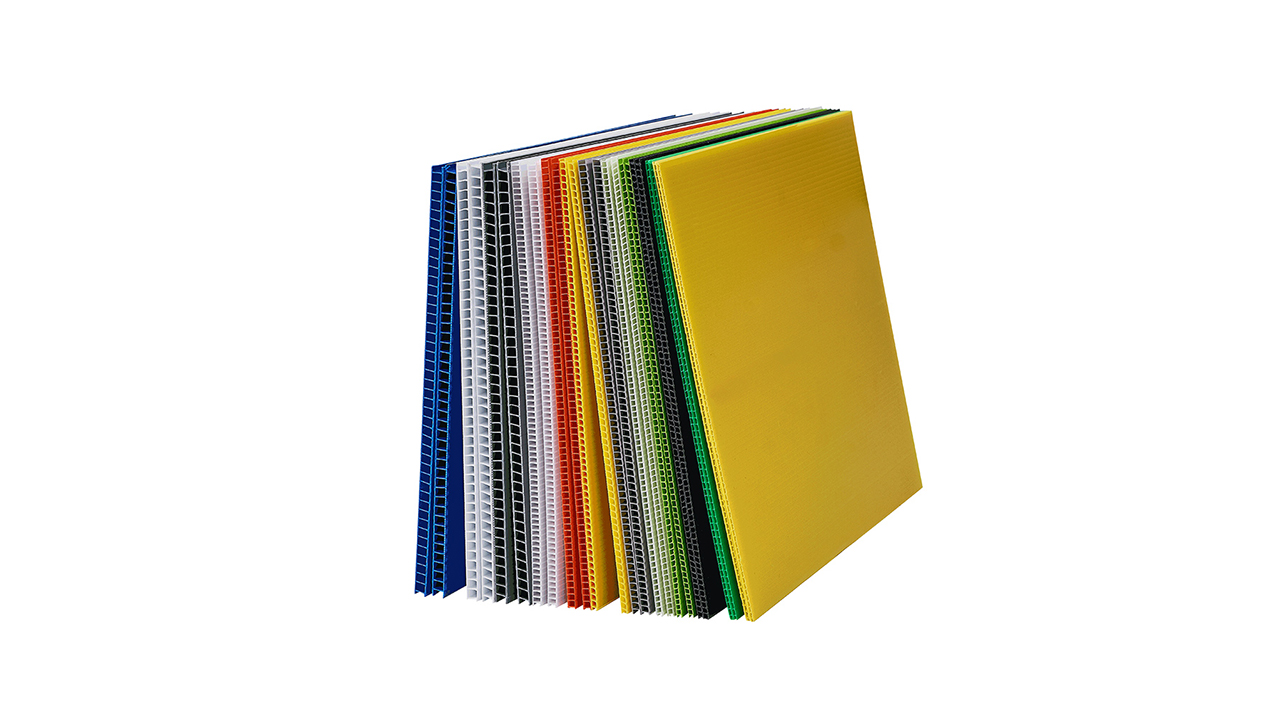
1. Composition of Corrugated Plastic
Do you know what is corrugated plastic made of? Corrugared plastic is known as PP corrugated sheet, plastic hollow sheet, or twin-wall polypropylene sheet, is composed mainly of PP resin, and there are three types of PP resin: Homopolymer PP (PP-H), Random Copolymer PP (PP-R), and Impact Copolymer PP (PP-B/PP-C). It also contains CaCO₃, pigments, and other useful additives.
1. Polypropylene (PP): The Main Material
Polypropylene is an essential component in corrugated plastic production.
This material is a thermoplastic polymer that is famous due to the following qualities:
- Resistance to impacts
- Lightweight
- Resistance to moisture and water
- Resistance to chemicals
- Sustainability
- Durable lifetime
PP comes in three major types. PP-H or Homopolymer PP serves best in making corrugated plastic sheets and industrial packing as well as signage. On the other hand, PP-R or Random Copolymer excels in packaging food as well as pharmaceutical products. Lastly, PP-B/PP-C or Impact Copolymer PP makes exceptional packaging for seafood packaging, meat packaging, crates and cold chain logistics.
2. Calcium Carbonate (CaCO₃): Improving Performance and Cost Efficiency
CaCO₃ is often used as a filler in PP corrugated sheets.
However, its function is not limited only to lowering costs. In proper proportions, CaCO₃ may enhance many of the materials’ characteristics, such as:
- Stiffness
- Dimensional stability
- Increased hardness of the surface
- Process ability
You must be sure that the ratio between PP and CaCO₃ is proper. The amount of CaCO₃ should range from 5-30 %.
Otherwise, the excessive amount of filler will decrease flexibility and impact resistance, whereas the proper mixture will produce a stable, stiff, and economically efficient material.
It is up to the professionals to determine the proper ratio of the material.
3. Pigments: Creating Customized Colors
Pigments are used to create different shades of colors and appearances.
Based on your demand, corrugated plastic sheets can be available in different colors like:
- Blue
- Black
- White
- Grey
- Green
- Colors that are custom made based on your requirements
Colors not only serve aesthetic purposes but also serve as identity markers, strengthen brands, increase safety, and help with sorting processes in the food industry. In the case of PP corrugated sheets, certain colors are used for particular purposes such as blue for hygiene, green for fresh products, white for clean packaging, red for handling requirements, yellow for sorting, and black for extra protection.
4. Functional Additives for Special Applications
One advantage of PP corrugated plastics is their ability to be modified by adding different functional additives.
Anti-Static Additives
There are some industries where static electricity can become quite a threat.
Anti-static PP corrugated plastics were designed in order to minimize static charge formation and are great for:
- Packing of electronics
- Moving semiconductors
- Storage of precision parts
In case your clients need extra protection for their sensitive goods, then anti-static plastic would come in handy.
UV Protection Additives
When corrugated plastic stays outdoors, it undergoes considerable stress from sunlight.
UV inhibitors increase resistance to ultraviolet rays and help prolong the life of the plastic when it is used for:
- Agricultural purposes
- Outdoor advertisements
- Construction protection
Flame-Retardant Additives
If your sector requires materials that have higher flame-retarding properties. using flame-retardant additives allows creating PP corrugated sheets that will meet stringent safety requirements when used in the automobile, electronics, electric machinery, construction, and aerospace sectors, where fire resistance is an important factor.
Conductive Additives
Conductive additives may be added for some special purposes to produce PP corrugated sheets with conductive properties. Such materials are useful in electronics, semiconductors, and the automotive industry.
2. Why Material Composition Matters When You Import Corrugated Plastic
Having information about the composition of the corrugated plastic supplied by your foreign supplier will help you assess its quality.
A reliable manufacturer must be able to tell you:
- the specific percentage of PP resins
- the types of additives added
- whether the raw material is recycled
- if it is fit for food grade use
- if there is an opportunity for customization
Depending on how the corrugated plastic is going to be used, different formulations may be required. A box to carry frozen foods, for example, will have different characteristics than the sheet for outdoor advertising.
3. Frequently Asked Questions (FAQ)
Q1.What additives are used for medical and food-grade PP boxes?
Medical and food grade PP containers depend on the use of additives to make sure they are both safe and strong. Their composition usually consists of 95% to 98% PP resin, 1% to 3% food grade masterbatch, along with other additives in small amounts that include antioxidants, stabilizers, pigments, and antistatic agents.
Q2.Why are anti-slip additives included in PP corrugated boxes?
Anti-slip additives are added to increase the grip on PP corrugated boxes. It makes sure that the box does not slip during handling, especially when stacking or transporting seafood, meat, and other heavier products.
Q3.Does corrugated plastic contain any dangerous materials?
Generally, polypropylene corrugated plastic does not contain toxic materials if it is made in accordance with safety regulations. However, additives and coatings may vary between products. In case you are planning to work with food, medicine, or other sensitive materials, check the manufacturer’s recommendations.
Q4.Why do food grade additives need to be added to PP corrugated boxes?
There is a need for the use of food-grade additives to ensure that PP corrugated boxes are safe for use in direct contact with food. These additives improve the quality of materials used, reduce deterioration, maintain appearance, and satisfy regulations for food use.
7.Conclusion
Once you know what goes into corrugated plastic materials, you can make decisions which will suit your clients and business objectives. Mainly, corrugated plastic consists of polypropylene (PP) and calcium carbonate, along with pigment and other additives in order to give required properties. For further information about PP corrugated products, visit PurePack.