
Layer placement on your pallets is a very important factor that will determine how efficient you are at work within your warehouse and the safety of your shipping process. No matter what type of product you may be shipping, whether it is cartons, beverages, or industrial products, proper stacking will help you make full use of your pallets.
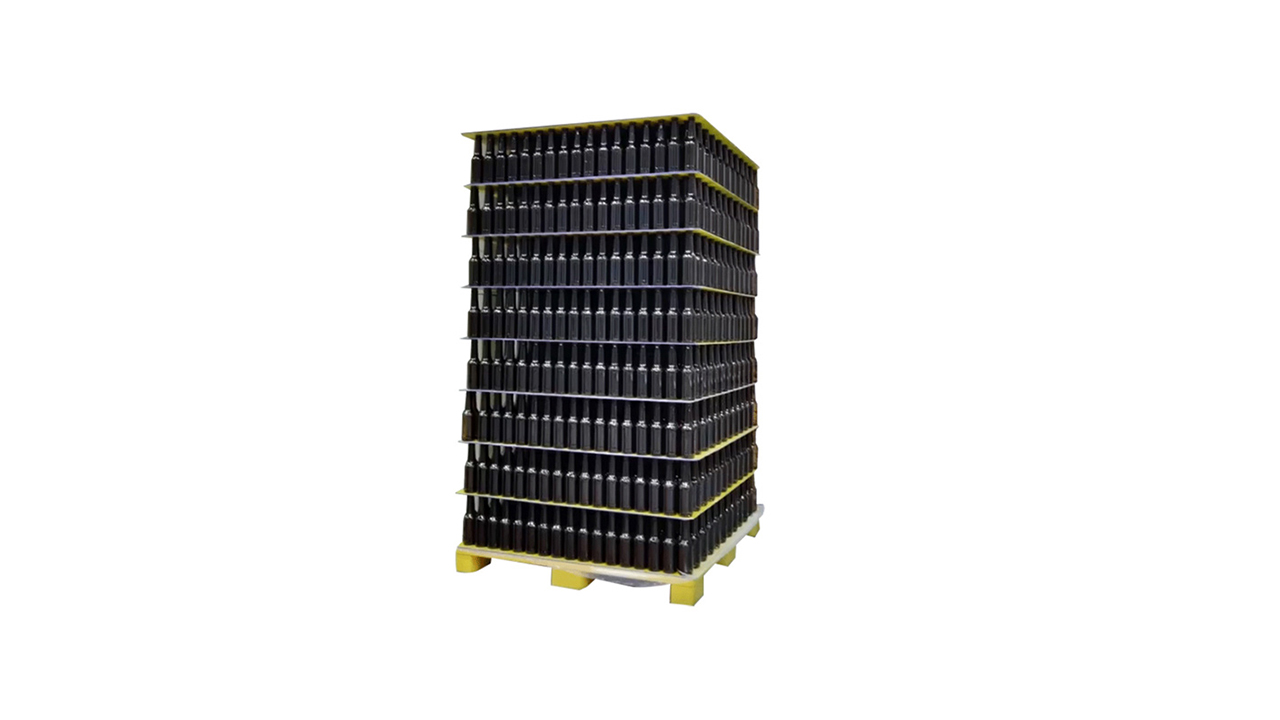
1. What Is Pallet Layer Configuration?
Pallet layer configuration means that it is essential for you to place the products, cartons or containers on the pallet in such a manner that there will be several layers stacked up.
The right configuration would ensure that you will be able to distribute the load evenly, avoid the shifting of the products and utilize the warehouse or shipment space effectively.
There is one common industrial measure known as Ti-Hi configuration:
- Ti: Number of cartons or packages in one pallet layer.
- Hi: Number of layers stacked one above the other.
- Pallet quantity: Ti × Hi.
If you have 12 cartons in one layer and 6 layers stacked together, then the total number of cartons in your pallet will be 72 cartons.
If each carton weighs 8 kg, and hence the total weight of the product would be 576 kg, excluding the weight of the pallet and the packaging materials.
This calculation is very vital to help you determine the number of shipments you require, warehouse storage and even give information to the suppliers on how to package.
But while maximizing the number of cartons loaded on the pallets, you must not overlook stability.
2. Common Pallet Stacking Patterns
Appropriate choice of packing will assist you in balancing the load stability, compression ability, and space efficiency.

2.1. Column Stacking
Column stacking is the arrangement of one carton above the other carton with the edges aligned perfectly in a vertical manner.
This will ensure that the weight of compression falls on the sturdiest edge of the carton.
Suitable for: Heavy cartons, warehouses, and products needing vertical compression strength.
Keep in mind that each column stands independent and is not fixed together. If you want, you could use the right stretching or corner protection method for your load.

2.2. Interlocking Stacking
In interlocking stacking, the cartons are set in alternate directions just like bricks in the wall structure.
This stacking will help you to enhance cohesion between adjacent cartons and prevent any sliding of the boxes horizontally.
Suitable for: Shipments that need to increase resistance to slipping during handling and shipping.
One weakness of this stacking system is that interlocked designs decrease compressive strength since the carton angles cannot be properly aligned vertically.

2.3. Pinwheel Stacking
This stacking technique uses carton rotation to create a pinwheel arrangement.
Depending on the dimensions of your carton, it can increase efficiency in the use of your pallet space and connect adjacent cartons together.
Suitable for: Items which due to their size cannot be stacked using a rectangular pattern.
This stacking technique requires that you analyze unsupported spaces within your load.
3. How to Calculate Pallet Capacity
To calculate the most efficient pallet arrangement, begin with your pallet and carton dimensions.
For example, consider the following parameters:
| Parameter | Measurements |
| Pallet Length | 1,200 mm |
| Pallet Width | 1,000 mm |
| Carton Length | 400 mm |
| Carton Width | 250 mm |
| Carton Height | 200 mm |
| Maximum Load Height, without the pallet | 1,200 mm |
Considering the alignment of the 400 mm side along the pallet length direction, it will be possible to accommodate 3 cartons along the length side and 4 along the width.
No. of cartons per layer = 3 × 4 = 12 cartons.
As the highest point where the load can be stacked is 1,200 mm, and the height of the carton is 200 mm, there will be 6 layers.
Capacity of your pallet loading = 12 × 6 = 72 cartons
And if each carton weighs 8 kg, then the total weight of your cartons is 576 kg.
4. Other Important Factors for Stabilizing the Load on Pallets
No matter how well you design the stack, you might overlook other important aspects which affect the stability of your load.
l Weight Distribution
The recommendation is that you should ensure your heavy items are on the lower level and that the load should be evenly distributed. An imbalance will result in an unstable center of gravity.
l Packaging Strength
Your packing should be able to endure stacking pressures when storing and transporting. Cardboard gets affected by moisture. Temperature changes, long storage periods, and frequent handling can lead to deformation. Use moisture-resistant PP corrugated containers, ensure proper thickness, reinforce corners, and determine the stacking height through compression tests.
l Pallet Dimensions
It is recommended that you pack your cartons within the dimensions of the pallet as far as possible.
This ensures edge protection and minimizes damage. Too much space can create problems with shifting cartons.
l Load Securing
Stretch wrapping, strapping, corner protection, and appropriate layer pads will help to hold your products in place.
But securing devices cannot fix all deficiencies in your structure. Your stacking scheme, packaging quality, and load securing should all go together.
5. How PP Corrugated Sheets Improve Pallet Configuration
PP corrugated sheets, also called corrugated polypropylene sheets, are light yet strong materials that are used in packaging and pallet separation.
- Improved Product Separation:PP corrugated layer pads ensure that your cartons and parts remain separated from one another, helping you to stack pallet layers and safeguard sensitive surfaces during transport.
- Resistance to Moisture:PP corrugated layer pads do not absorb moisture, thus being perfect for use in humid storage rooms, refrigerated storage, and for international shipping.
- Light Weighted: Their light weight makes handling easy and keeps extra weight of packaging at the minimum level.
- Reusability and Cost Efficiency:When you reuse one layer pad for 20 trips instead of using 20 pads which would be replaced after each trip, then theoretically, you can cut down the use of replacement pads by about 95%.
As a PP Corrugated Sheets manufacturer, we can provide customized thickness, sizes and colors according to your pallet specifications.
6. The Role of PP Corrugated Boxes in Pallet Configuration
PP corrugated boxes offer you light and reusable packaging options to meet your pallet configuration requirements.
- Customized Size Options:There are possibilities for you to select the size of boxes based on your requirements. As an example, if there is a pallet that has dimensions of 1,200 x 1,000 mm, there can be placement of 12 boxes that have dimensions of 400 x 250 mm per layer.
- Durable and Recyclable: These boxes are resistant to moisture and are durable enough to be shipped many times if needed, and thus your packaging can be reduced considerably.
- Collapsible Box:Collapsible PP corrugated boxes can be collapsed after emptying and assist you in saving money both on transportation and on storage. Your savings will depend on the design of your box and foldability ratio.
In planning your palletizing arrangement, keep in mind your sizes of loaded containers, maximum capacity, and unloading and re-loading. As experts in PP corrugated sheets, we provide tailor-made packaging solutions to meet your needs.
7. Frequently Asked Questions
Q1: Which stacking pattern is most suited to your plastic layer pads?
You need to use an interlocking brick pattern for your boxes, which are separated by a flat PP pad. This will help secure your entire load, prevent any movement inside, and keep your heavy pallets upright even on sharp turns.
Q2: How do PP corrugated pads protect your boxes against forklift blade scraping?
Careless forklift drivers tend to scrape the lower layer of your pallet during pick up operations. Adding a robust PP corrugated pad to your lower pallet deck will serve as a strong barrier to any blade impacts that may damage your retail boxes.
Q3: In what way is pallet configuration affected by vibration?
The vibration on roads/railways makes the boxes move around and rub against one another, causing wear and tear on your packaging as well as weakening your cardboard. Tight and interlocked configuration makes sure that your boxes move as one, hence preventing friction.
Q4: Why should you not stack plastic boxes with cardboard boxes on the same level?
Stacking materials having differing levels of friction and compression results in imbalance shifting. Your slippery plastic boxes are likely to shift against your cardboard boxes while being transported, resulting in imbalance and making your pallet unstable.
Q5: Why do you need to check the thickness of your wooden pallet boards before loading anything onto them?
The reason is that thin or warped boards will sag under the load, causing your lower levels to lean inward. It is crucial that you check your pallets for even board thickness to create a perfect level surface.
8. Conclusion
A good configuration of your pallet layer design will help you to ensure that you get maximum stability of loads, protection of goods, and efficient utilization of your storage space and transportation. With the use of the correct stacking method along with PP corrugated sheet and box, you will be able to create your packaging system. Visit us at PurePack for more details.