
When you have to import ESD corrugated plastic boxes, only the appearance cannot be relied on as an assurance of good protection from static. The various products can be alike but there can be significant differences in their materials, electrical properties, durability, and quality of production. In this article, you will discover how you can assess good ESD boxes.
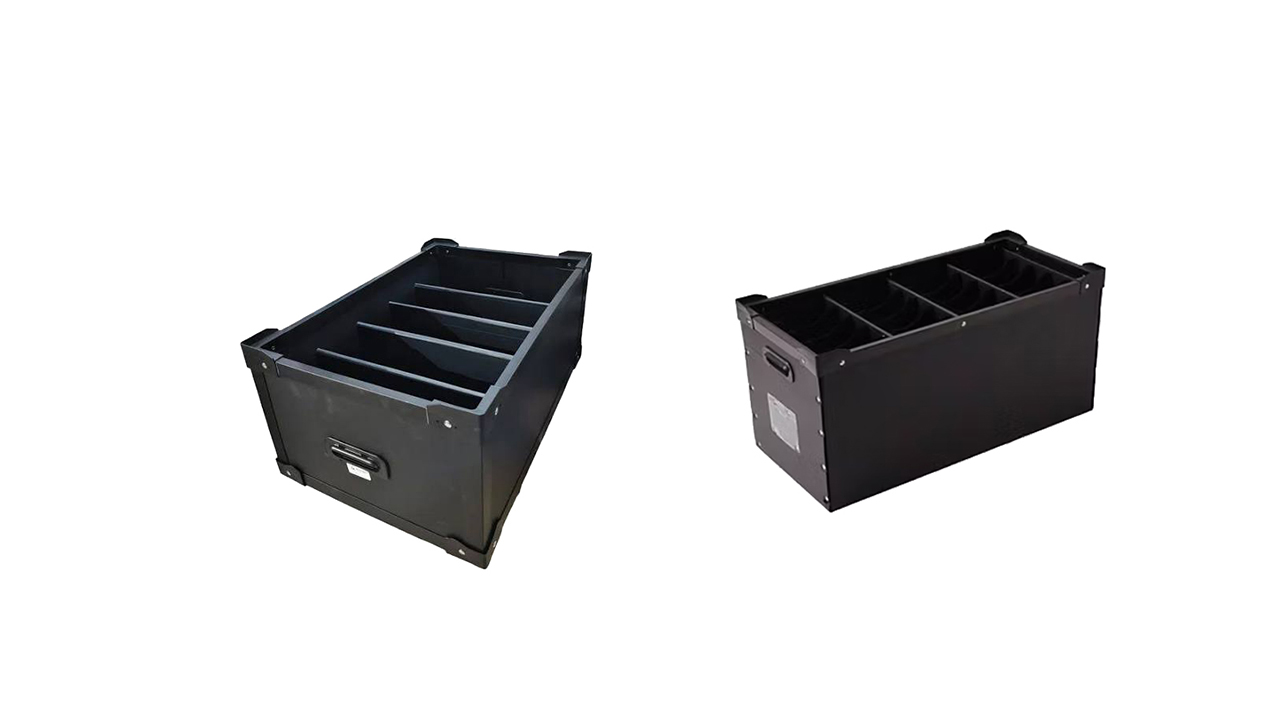
1. What Is ESD Corrugated Plastic Box?
ESD corrugated plastic box is made of ESD corrugated plastic sheet. It is used to protect electronic components from static electricity. Their surface resistance is regulated to be between 10⁶ to 10⁹ Ω. Every batch has a test report.
Their thickness varies from 3-12mm in standard size or customized size and also with customized colors and an optional corrugated plastic dividers. The ESD corrugated plastic boxes are lightweight and waterproof and can be folded for shipping purposes. You can use them for PCBs and electronic components.
2. Understand the Main Types of ESD Corrugated Plastic Boxes
Your ideal ESD box will depend on the way you transport, store, and handle your electronic components. Below, I list four types of boxes which you might see when sourcing ESD packaging from abroad.
l Anti Static Turnover Box
The most standard ESD box that is used to handle and store electronic components, PCB boards, and precision parts. The popular sizes are 18 × 12 × 6 inches, 24 × 16 × 8 inches, 3mm thickness, and surface resistance of 10 ⁶ -10 ⁹ Ω.
Anti-static turnover boxes are designed to be constantly handled and circulated through production, storage, and transportation sites. Being reusable, such boxes are perfect for your factory and supply chains that include constant reuse of containers.
In evaluating this type of box, you need to check the box rigidity, its folding or stacking system, load capacity, and ESD performance. Also, the material must retain its static control property during repeated usage.
l ESD PP Corrugated Box With Dividers
ESD PP corrugated box with dividers can be considered an optimal solution when you have to organize separate placement of several electronic components within one packing.
Dividers protect components from touching each other and minimize their movement while transporting. This option is perfect for small electronic parts, automotive components, precision components and other goods requiring separate storage.
Inspecting the box, don’t consider only its external structure; pay attention to the material, thickness and fit of the dividers. Dividers must be fixed securely and shouldn’t cause any damage to the components.
For example: Light parts <0.5 kg 1.5 to 2.0 mm for normal fit, medium parts (0.5–2 kg) 2.0–3.0 mm for Snug fit and heavy parts (>2 kg) 3.0–5.0 mm for tight/supportive fit.
Also, you should pay attention to the design of the divider system. The number, arrangement and size of the compartments should correspond to the sizes of your products. Usually, a professional manufacturer can adjust the divider system according to your components..
l ESD Stackable PP Corrugated Boxes
Stackable ESD corrugated boxes are made with the goal of providing the most efficient storage and transportation by facilitating vertical stacking of boxes.
Stacking might be especially important for you, as boxes take up considerable space while stored in warehouses and during transportation abroad.
To be considered stackable, an ESD box should be able to withstand the load. At the same time, the stacking should protect the boxes from sliding and collapsing.
Prior to ordering the boxes, you should ask the seller how high it is recommended to stack them and what load they should be capable of withstanding. You should test the boxes’ capacity to withstand the load while actually stacked in seaports or warehouses.
l Custom Size ESD Plastic Boxes
Although standard ESD boxes are convenient to use, at times they might not be suitable for all types of components. Customized ESD plastic boxes can be designed depending on the dimensions of your components, storage arrangement, manufacturing line, or shipping.
The customization process involves customizing the size, length, width, height, thickness, color, partition design, printing, and design structure of the boxes.
Customization is able to help save space and provide excellent protection for your products. The only thing that you need to watch out for during customization is dimensional tolerance.
Inform your packaging supplier about the dimensions of your products and the use of the boxes.
3. How to Choose the Right ESD Corrugated Plastic Box for Your Needs
1. Check Surface Resistance
Surface resistance is an important indicator to look at when selecting ESD packaging. Depending on your needs, you may want conductive, dissipative, or antistatic material.
When checking an ESD PP corrugated box, ask your supplier the following:
- What is the surface resistance?The common value of surface resistance for such products is 10⁶–10⁹ Ω based on your requirement.
- What is the method of testing?Request a recognized testing method such as IEC 61340-2-3.
- Could you give me a test report?It must include the value of resistance (Ω), method of testing (surface resistance test), testing condition (temperature and relative humidity), and information about the product (grade, product name or lot number).
- Is the test carried out on a finished box?Your supplier should measure ESD performance of your box, not the PP sheets only.
2. Look for Consistent ESD Performance
A good quality ESD box must offer protection in all boxes in your order; not just the sample you test. Prior to mass production, request samples from various lots and test their electrical properties. Your supplier must be able to control the properties of the raw materials used, ESD additives, extrusion of the sheets, thickness, surface finish of the sheets, box construction, and quality checking.
3. Inspect the Thickness and Mechanical Strength
Examine thickness, flute formation, edges, stiffness, and jointing. The standard PP corrugated sheet thickness is between 3 mm and 12 mm, but your needs may differ. Get an estimate of maximum loading from your supplier and conduct tests in a similar environment as you do your shipping.
4. Examine the Surface and Appearance
The surface of your ESD box needs to be even, the color must be consistent, and it must have clean edges and proper dimensions. Look out for any cracks, blisters, lifting layers, warping, or thickness inconsistencies. Corner and joint areas need to be sturdy and neatly finished. Proper dimensions are key in custom-made boxes because you need to be sure they will fit your components, racks, shelves, or production machinery.
5. Check Whether the Box Is Suitable for Your Environment
Your environment may have an impact on how well the ESD box performs. Temperature, humidity, storage duration, handling, moisture, chemicals, and transport conditions are some of the factors to consider. In case you want your boxes in dry, humid, or varying conditions, make sure to communicate that to your supplier.
6. Compare Samples Before Comparing Prices
If you are an importer, you need to be more concerned about the quality of products than their prices. Ask your suppliers to send you samples to compare the quality of their products with other suppliers. You can check the material, surface resistance, thickness, strength, dimensions, appearance, assembly, and other features by comparing the samples.
4. Frequently Asked Questions
Q1.Can an ESD box lose its static-control properties over time?
Yes. It could happen due to deterioration in the electrical characteristics of your ESD container. You need to find out from your supplier how the ESD performance is assured for the intended life of the product.
Q2.Can folding and cutting have an impact on ESD properties of your PP corrugated box?
Yes. Various manufacturing operations, such as cutting, creasing, folding, welding, and assembly, may affect the final product. It is important to test the final box for its ESD properties and not just rely on the raw sheet tests.
Q3.Why does batch traceability matter when you import ESD boxes?
Batch information will help you track down the source of the problem if there is any quality issue. For large orders, you may request your supplier to give you some batch information.
Q4. Does the ESD performance of your box depend on the raw PP material?
Yes. The type of PP, the conductive or antistatic additive, and manufacturing process could influence the electrical performance. You need to ask your supplier about their control of the raw materials batch to batch.
Q5.What is the recommended method for storing ESD PP corrugated boxes prior to usage?
Store them in a clean and dry location, free from direct sun exposure, high temperatures, chemicals, and contamination. Make sure to follow the storage instructions provided by your supplier.
5. Conclusion
When you are selecting a suitable ESD corrugated plastic box, there is more to consider than just the look or cost of the packaging box. You need to consider surface resistance, material, consistency, thickness, durability, size, and test report of the boxes. With proper comparison of samples, you can select ESD boxes that will ensure your products get adequate protection during storage, handling, and transit. Please visit purepack for more information on ESD corrugated plastic box.