
In this article, you will learn about the major difference between PP and PE plastics, how to easily distinguish between them, and how to test your plastics for better results. You will also be guided on what you need to know before ordering from foreign plastic companies.
1. PP vs. PE: How to Know the Difference?
Both PP and PE are thermoplastics. However, they have different structures and properties.
PP refers to polypropylene. It is a light thermoplastic which is known to be stiff, chemically resistant, durable and has decent heat resistance. PP is used for packaging, automotive parts, storage items, reusable containers, sheets and other various industrial purposes.
PE refers to polyethylene. This type of plastic is probably one of the most popular in the world. Polyethylene is available in several types: LDPE, LLDPE and HDPE. According to the type, PE may be flexible or rigid.
As different types of PE have their own features, you shouldn’t think that all PE materials will act similarly.
1.1. Identify the Plastic Identification Code
Start your analysis at the product marking.
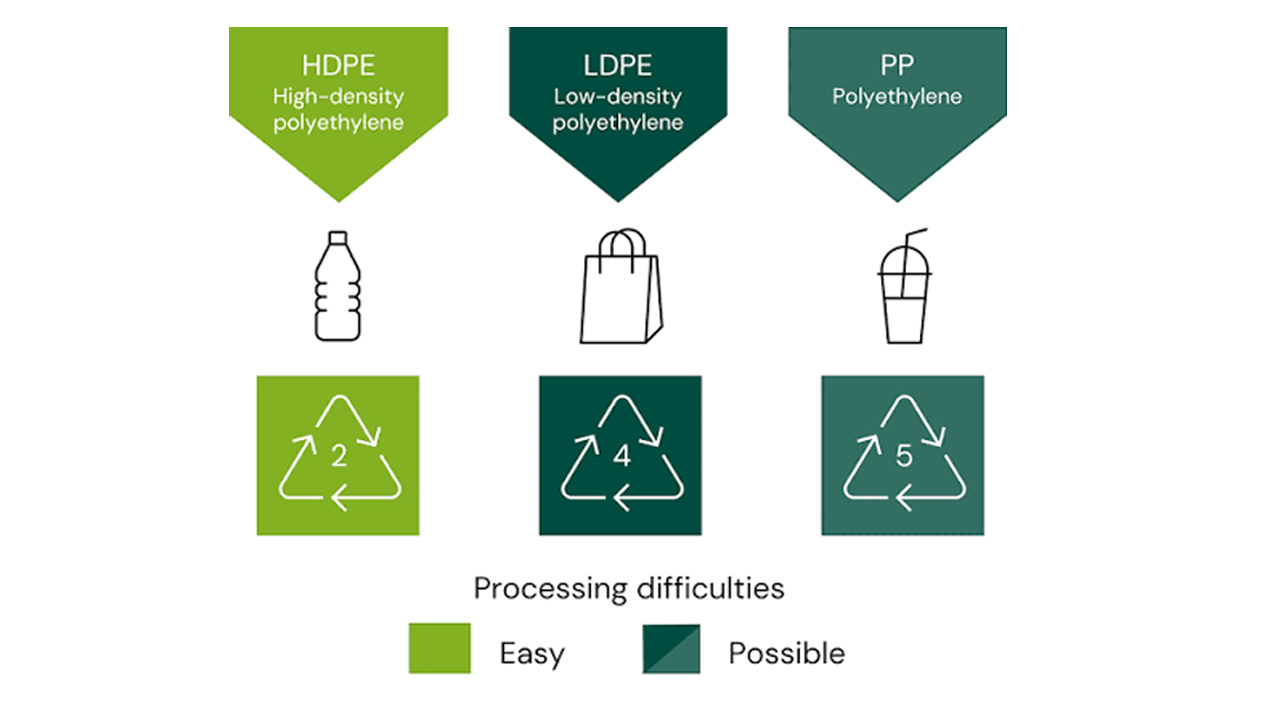
Some plastic products will show you a resin identification code in the form of numbers enclosed in a recycling logo.
- PP = #5
- HDPE = #2
- LDPE/LLDPE = #4
In case you spot a #5 code, it is usually polypropylene, #2 is high-density polyethylene, and #4 is low-density polyethylene.
But not all plastic products are accompanied by a recycling logo. Plastic films, custom-made items, and industrial plastics do not always have a code on them.
Keep in mind that a recycling logo will only tell you what type of resin was used for the product, but it may not be enough for you to know its entire composition.
1.2. Evaluate the Flexibility and Rigidity
You can usually determine this at the first stage by touching the plastic.
Polypropylene (PP) tends to be stiffer and more rigid than many common polyethylene (PE) plastics. It is likely to retain its shape well, and will be fairly stiff to the touch.
PE may be more flexible than PP, especially in the form of low density (LDPE) and linear low density (LLDPE). On the other hand, high density (HDPE) is quite stiff.
For example, when you are comparing a PP corrugated sheet to a PE sheet with the same thickness, the PP sheet will feel relatively stiff despite being light-weight and manageable.
Again, it is just an initial test. Different grades and thicknesses will yield different outcomes.
1.3. Evaluate the Surface and Appearance
PP and PE can both be made with smooth, textured, glossy, and matte surfaces. Appearance cannot therefore be used to identify the material alone.
However, if you are familiar with a certain product, you will note differences in:
- Texture of the surface
- The degree of glossiness
- Translucency
- Stiffness
- Thickness uniformity
- Flexibility
For your information, PP has a hard, stiff, and shiny surface, giving it a neat look, whereas PE has a soft, flexible, and waxy surface.
1.4. Perform a Float Test
In your float test in water, you will realize that PP and PE float because their densities are less than that of water.
In the case of PP, you will observe that PP floats freely having a density of about 0.90-0.91 g/cm³.
On the other hand, PE will float having a density of about 0.91-0.97 g/cm³.
From the above observations, it is clear that you cannot differentiate between PP and PE using the water float test.
1.5. Consider the Melting Point
Another significant difference is the melting properties.
Usually, PP has a greater melting point compared to other grades of PE. The standard melting points are about:
- PP: ~160-170°C
- HDPE: ~130-135°C
- LDPE: ~105-115°C
These ranges may vary based on the grade and composition.
In order to examine the melting properties of the plastic, one could perform a controlled thermal analysis in the lab. It is much more accurate than heating the sample on your own.
If you are a distributor who buys a big amount of plastic products, then conducting professional material testing would be a much safer choice than heating the sample.
1.6. Ask Your Supplier for Material Documentation
One of the simplest methods of determining material for foreign purchasers is asking your supplier for documentation.
Based on your products and your purchasing needs, you can ask your suppliers for:
- Material specification
- Technical data sheet (TDS)
- Safety data sheet (SDS) where appropriate
- Certificate of analysis (COA)
- Raw material information
- Grade or resin specification
- Third party testing results
You should also make sure the documentation corresponds to the actual product being supplied.
1.7. Use Laboratory Testing for Important Orders
In case you require a very high level of assurance, laboratory testing is definitely the way to go.
Some of the methods available for identifying the polymer include:
- FTIR (Fourier-transform infrared spectroscopy)
- DSC (Differential Scanning Calorimetry)
- Density tests
- Thermal analysis
The most common way of identifying the chemical composition of a polymer is FTIR while DSC helps in identifying melting point and other thermal properties.
A test of a production sample before shipping in case of an important order may prove beneficial for you.
2. Why Does PP vs. PE Identification Matter to You?
For you, it is not only a technical issue to classify the material.
You could be ordering PP because your customers require certain characteristics such as rigidity, lightweight, resistance to chemicals, durability, or high temperatures.
If the supplier uses some other material without your consent, it will behave differently.
For instance, a client buying PP corrugated sheets will probably have certain needs regarding:
- Rigidity of the sheet
- Its weight
- Resistance to impact
- Resistance to chemicals
- Folding
- Printing
- Reusable
- High temperatures
So it could affect your product quality and your customer satisfaction.
3. Frequently Asked Questions
Q1. Is HDPE easier to distinguish from PP than LDPE?
In some cases, HDPE may be more easily identifiable because it is usually more stiff and denser than PP. LDPE, on the other hand, is relatively flexible and hence more difficult to identify from some PP materials.
Q2. Can recycled PP and PE look different from virgin material?
Yes. The recycled plastics will differ in their color, clarity, and surface appearance due to prior handling and contamination. But it does not mean that it can be used for the identification of polymers, since you still need to conduct tests.
Q3.Can additives change the appearance of PP or PE?
Yes. Additives can considerably affect the appearance of both polymers. For example, colored or filled PP will have completely different properties compared to PP in its original form; the same for PE.
Q4. Does PP feel different from PE when folded?
Yes. PP is often crispier and may not bend easily before making a crease, whereas PE is usually soft and bends easily. Folding films multiple times will help you notice the differences between them more easily.
Q5. Can color help you identify PP or PE?
No, because the color does not work as an identifying factor for the polymer. These two polymers may be manufactured in different colors by using pigments and masterbatches. Thus, the white, black, transparent, or colored sample may belong to any of the two polymers.
4. Conclusion
PP and PE may appear alike, but they are quite different when it comes to their properties. If you want to be sure about what plastic you have, you must verify the resin identification code and properties of the plastic. If you wish to be absolutely certain, you must obtain technical data.
Visit Purepack for more information on PP.