
The choice between corrugated plastic signs and aluminum signs impacts your cost of purchase, durability, shipping cost, and profit margin. If you are importing signage materials or supplying sign makers, knowing the differences will help you choose the right product. This article gives an insight into the cost, weight, durability, outdoor performance, and print quality.
1. What Are Corrugated Plastic Signs and Aluminum Signs?
Corrugated Plastic Signs: They are made from Polypropylene (PP), which is a light-weight and thermoplastic material having two flat surfaces separated by hollow fluted cells. Corrugated plastic is rigid but consumes less material in its production. You can use them for your real estate signs, yard signs, construction signage, promotional display boards, and temporary outdoor signage.
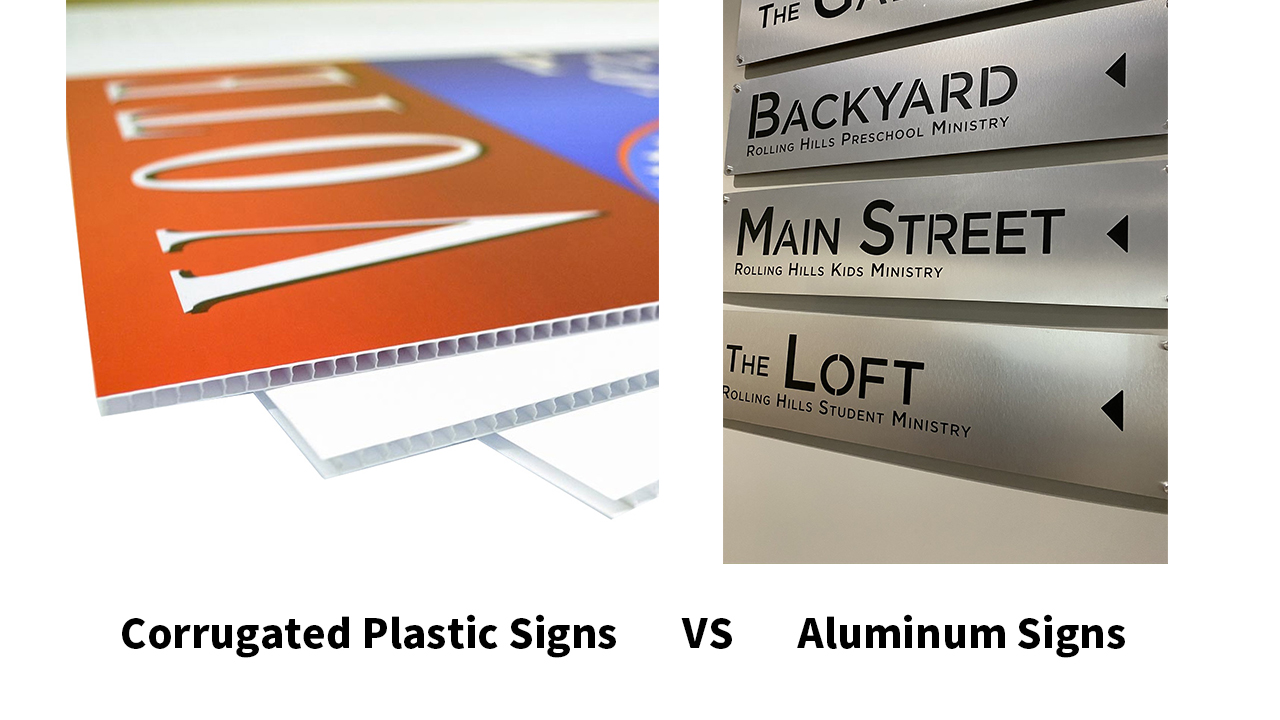
Aluminum Signs: They are made using solid aluminum plates and also Aluminum Composite Panels (ACP). Solid aluminum gives the sign a metallic look, while ACP has two thin layers of aluminum attached to the core, usually made of polyethylene. Since these materials have different construction, you should make sure to compare equivalent products when checking for supplier quotations.
You can use aluminum signs for your permanent business signs, parking signs, building directory, and industrial identification signs.
Which one is better? It all depends on your budget and applications.
2. Corrugated Plastic Signs vs. Aluminum Signs
1. Price Comparison: Which Material Is More Cost-Effective?
Your material costs significantly impact your profit margin. Corrugated PP signs are relatively cheaper than aluminum sign materials.
The bulk price ranges for blank sheets of size 4*8 feet are as follows: $2.5-$8 for blank corrugated PP signs, $18-$35 for solid 3003 aluminum signs (0.040-inch thick), $20-$40 for solid 5052 aluminum signs (0.040-inch thick), and $12-$25 for 3 mm aluminum composite panels (ACP).
Your costs are determined by material specifications, order quantity, and material supplier pricing. Printing, coatings, packaging, international shipping, insurance, duties, and local delivery costs will increase your total cost.
Corrugated PP sheet is a more economical option for you if you need temporary advertising and promotional signs. Aluminum is a better long-term choice if you require outdoor signs.
2. Weight Comparison and International Shipping
Weight is an important factor to consider when you are importing signage material in bulk.
For example a standard 4 mm corrugated PP sign will weigh about 0.7-1.0 kg/m², depending on the density and structure of the material. An 8×4ft corrugated plastic sign, which is about 2.44×1.22 m, will therefore weigh around 2.1-3.0 kg.
In comparison, a 0.5 mm solid aluminum sheet will weigh around 1.35 kg/m², whereas 3 mm aluminum composite panels are known to weigh 3-4 kg/m².
These values are estimates for indicative purposes, check the exact weight with your producer prior to ordering.
One advantage of using a light corrugated PP sign is ease of handling and installation. It can also decrease your cost of freight shipping, if the rate is calculated based on actual weight. However, flat sheets still occupy cargo area; thus, volumetric freight cost is still a matter of importance.
Before you proceed with importing, be sure to ask for the following information:
- Weight per sheet and per square meter.
- Sheet size and thickness.
- Packagesize and gross weight.
- Number of sheets per pallet, per carton and per container shipment size and volume.
- Approximate number of containers loaded per shipment.
3. Durability and Outdoor Lifespan
Durability will depend on the substrate, quality of manufacture, environment, and your installation.
Corrugated PP signs are waterproof and will not rust. The fluted structure provides useful stiffness while allowing the panel to flex under certain impacts.
However, polypropylene without treatment might deteriorate with long exposure to UV light, causing brittleness. The print could possibly fade, depending on the ink used and the duration of exposure to sunlight. Wind could cause damage to your thin sheets and tearing of the mounting holes if your signs are inadequately supported.
Many regular signs made from corrugated plastic give approximately 6-18 months of outdoor service in average conditions, but some signs may last longer 1-2+ with UV stabilized materials and proper printing systems.
Aluminum signs usually offer more rigidity and are good for a lot of permanent installation jobs. When properly chosen, aluminum signs will not corrode, but the coatings, fasteners and your environmental conditions influence durability.
Some of your aluminum composite signs can last up to 3-7 years or more in the outdoors, while an appropriate aluminum system can last much longer. These are just rough estimates and not warranties on products.
It is vital for your clients to know what type of signs they should get, depending on their purpose – temporary one or a long-lasting sign.
4. Printing Quality and Customization
Your clients might also look at your materials in terms of print quality, appearance and possibilities for customization.
Corrugated PP signs can be used for screen printing and UV printing when their surfaces are suitable with the ink system that you choose. The surface energy of polypropylene is rather low and therefore corona treatment or other surface treatment might be required for proper ink adhesion.
Possible options for your customization include:
- standard and customized sheet size,
- white and colored sheets,
- single-side and double-side printing,
- custom cutting and drilled mounting holes,
- UV stabilized material for appropriate outdoor applications.
Aluminum signs can be used for high quality graphics using direct UV printing, screen printing and vinyl application. The smooth and rigid surfaces make them ideal for your professional signs.
Other aluminum products could include painted, reflective graphics, and coatings for your special purposes.
When you are ordering printed products, ask for samples to test color consistency, adhesion, scratch resistance, and outdoor performance.
If you are importing unprinted PP sheets for local printing, ensure that the surface treatment and printing quality is appropriate before making a bulk purchase.
5. In summary
| Comparison Factor | Corrugated Plastic (PP) Sign | Aluminum Sign |
| Composition | Polypropylene | Solid aluminum or aluminum composite panel |
| Typical thickness | 3–6 mm | Approx. 0.5–3 mm for most solid sheet and ACP approx. 3–4 mm overall |
| Material weight | Approx. 0.7-1.0 kg/m² for most 4 mm sheets | Approx. 1.35 kg/m² for 0.5 mm solid aluminum and 3-4 kg/m²for most 3 mm ACP panels |
| Indicative blank-sheet cost | Around $3-$8 per 4×8 ft sheet for some supplier | Depends on alloy used, sheet thickness, finish, etc. and can be up to $12-$40 |
| Outdoor application lifespan | About 6-18 months in many cases of standard printed signs, with adequate UV protection, can be much longer 1-2+ | 3-7+ years and longer depending on materials in use |
| Water resistance | Excellent | Excellent when properly specified |
| Rigidity | Moderately rigid, depending on thickness and structure | More rigid, especially in solid aluminum construction |
| Methods of printing | UV printing, screen printing, also suitable for digital printing | Direct UV printing, screen printing, and applied vinyl |
| Customization options | Cutting, drilling, custom colors, printing | Cutting, drilling, coatings, printing, and reflective surfaces |
| Common uses | Temporary signs, promotions, and events | Permanent signs for businesses and industrial facilities |
| Advantage for shipment | Light weight | More rigidity, weight varies depending on construction |
3. Frequently Asked Questions
Q1: In what ways do your installation and hardware costs vary according to materials?
For your corrugated plastic signs, all you need is cheap wire H-stakes to push the signs into the ground. But your aluminum signs would need u-channel posts, wooden poles, or wall mounts, making them more expensive to install.
Q2: What are the exact environmental causes that will make your signs fail?
Your plastic signs will be made brittle by extreme UV rays, and the high winds can fold your signs horizontally. However, your aluminum signs will never structurally fail; instead, your graphics or vinyl overlay will just fade and peel off.
Q3: Is it easy to recycle these signs after your campaign?
Aluminum can be recycled easily for cash at the local yards. Although your plastic signs are made up of recyclable Polypropylene, they cannot be put out for recycling in your residential curb-side collection boxes. They have to be taken to specialized commercial drop-off facilities.
Q4: Will rusting or chemical contact harm your signs when placed for a long period of time?
Industrial chemicals and salt air at the coast will never cause rusting on your corrugated plastic signs. But the raw aluminum that is not sealed may rust over time, compelling you to buy anodized or powder-coated metal signs.
Q5: Which material is better for your indoor retail display stands?
You should use corrugated plastic for your indoor store displays because it is light in weight, cheap, and easy to hang from the ceiling. Aluminum displays are heavy and a safety risk due to falling on your retail customers and employees.
4. Conclusion
These signs fulfill varying business requirements. For PP corrugated, one can find low weight and affordable options for their promotional signage, whereas aluminum can be used for various permanent installations. Comparison of the validated features, outdoor life, print quality, and prices will help you choose appropriate products and satisfy your clients. For more information, contact Purepack.