
Choosing the appropriate plastic sheets is vital when you purchase materials for your packaging, printing or industrial purposes. White corrugated plastic sheets are ideal since they have properties of being light, durable, and versatile. In-depth knowledge of these sheets makes one choose the best materials for purchase.
1. Main advantages of white corrugated plastic sheets
1.1. A Clean White Surface for Professional Printing
White plastic sheets give you a clean surface which will be great when it comes to printing purpose, plastic signs, plastic box, and other marketing needs. The white surface of the plastic sheet ensures that your graphics and letters are clearly visible.
If you own a printing business, then white PP corrugated sheets will serve as good material for real estate signs, retail displays, exhibitions, and directional panels. White sheets can also be used to produce dividers, inserts, and boxes.
Choosing white sheets will ensure effective inventory and designing. However, polypropylene sheets have low surface energy, which makes the surface non-receptive to ink. Corona treatment is used to enhance surface wettability. Ensure that the ink is compatible with your surface before placing an order.
1.2. Lightweight Construction with Practical Rigidity
If you buy bulk plastic sheets, you have to keep in mind their material weight and convenience of handling.
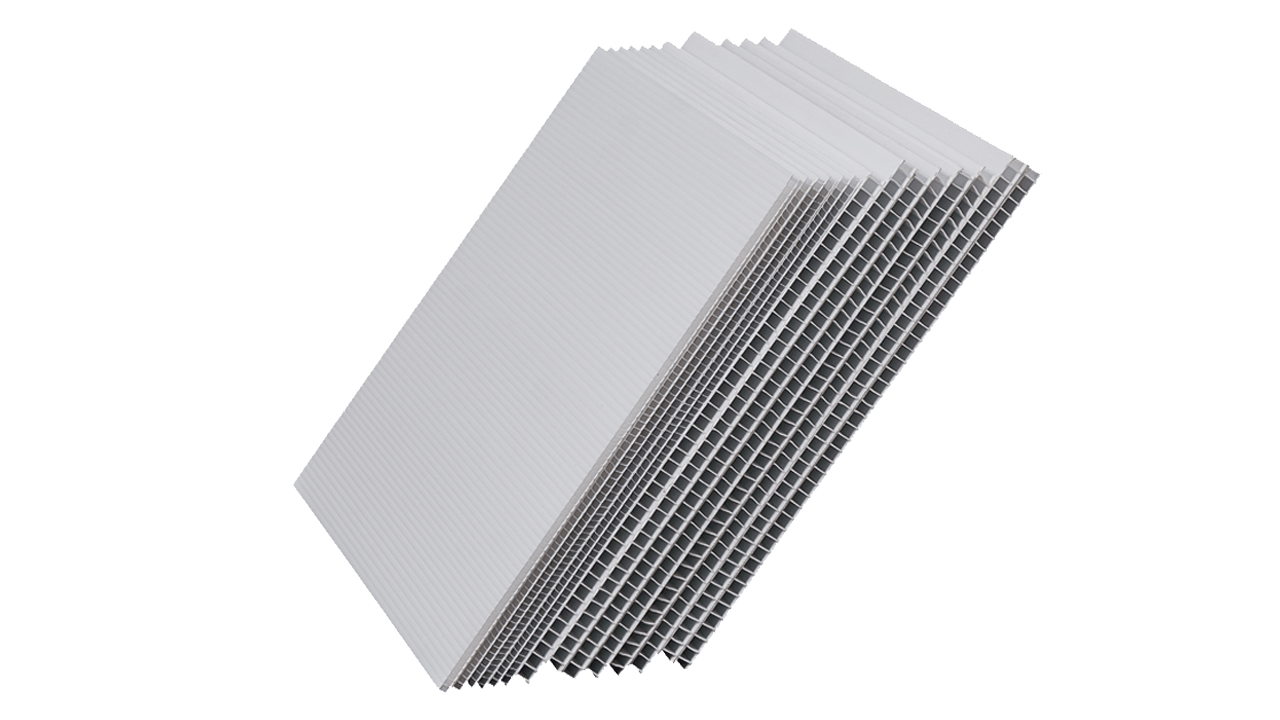
White corrugated plastic sheets consist of two flat parts joined by flutes between them. This makes the sheets practical but light, not being as heavy as solid plastic sheets.
Corrugated polypropylene sheets are made in thicknesses of 2-10 mm and grammages 250-1,950 g/m² depending on the manufacturer and product range.
Let’s take, for example, one sheet with size 1,220 × 2,440 mm and grammage 750 g/m².
The approximate material weight of this sheet will be:
1.22 m × 2.44 m × 750 g/m² = 2.23 kg per sheet.
This formula will help you calculate the material weight while planning your stock and transportation. For example, 1,000 sheets of such grammage will be 2.23 metric tonnes of material, excluding the weight of pallets and protective wrapping.
In your business, you can choose an appropriate grammage to make the material handling easier and decrease the weight of your products. However, you should think about rigidity, loading needs and application conditions instead of choosing the lightest sheet available.
1.3. Resistance to Water and Moisture
Resistance to moisture is yet another benefit of polypropylene corrugated sheets.
Unlike paper-based corrugated sheeting, polypropylene will not absorb moisture like cellulose fiber does. Thus, PP sheets are a good choice for applications with moisture, spills, and general exposure to water.
White corrugated plastic sheets can be used for your reusable packaging, warehouse separators, protection sheets, industrial partitions, layer pads and some agricultural applications.
If your customers live in humid climates, moisture resistance can be especially useful. The material will retain its basic integrity in wet environments where untreated paper-based products would become soft or weak.
If your customers need regular cleaning, outdoor use, or chemical resistance, make sure that the selected grade is right for their particular application.
1.4. Durability and Reusability Across Industries
When buying materials for your commercial activities, you should buy products which can stand handling, storing, transporting, and using them several times, if required.
Corrugated plastic sheets are durable and light. Depending on the sheet thickness, weight, and structure, you can make from them protective packaging, reusable boxes, layer pads, partitions, and displays.
Thus, packaging companies can use PP sheets for separating products during transportation. Printers can use them for making advertisements, while industrial suppliers can manufacture containers and protective products.
The reusability of packaging material can provide additional benefits if the final product will survive several handling operations. Your customers will replace the product less often than single-use materials, depending on their applications and operating conditions.
The real life of the product depends on impact, abrasion, loading, temperature, UV radiation, and handling conditions. If you plan to sell the products for industrial purposes, you should conduct tests of the material in real working conditions before manufacturing a large quantity of products.
1.5. Easy Processing and Flexible Customization
Your clients might need sheets of various dimensions, thickness, weight, and processing techniques. PP corrugated plastic provides the option for flexible processing in different converting processes.
Among others, common processing techniques include cutting, creasing, die cutting, folding, stapling, stitching, and heat welding.
As a result, the white corrugated plastic becomes applicable for manufacturers of custom packaging, retail displays, protective inserts, document cases, and industrial containers.
If you are buying from a manufacturer, you can choose among several customization options such as:
- Thickness:Usually 2-10 mm, depending on your application and desired rigidity.
- Grammage:Usually 250-1,950 g/m², depending on thickness, flute design and material density.
- Dimensions:Standard sheet sizes are 1,220 x 2,440 mm, 1,000 x 2,000 mm and 1,200 x 2,400 mm. Custom sizes are possible to minimize material waste.
- Surface treatment:Corona treatment boosts surface energy, improving ink adhesion in screen printing and flexographic printing. Flame treatment and plasma treatment are additional methods of improving surface wettability of polypropylene. Your supplier can recommend the right choice based on your printing process.
- Additional properties:UV stabilization helps to minimize weathering effects outdoors, antistatic and flame-retardant grades are also available.
Such a selection of options allows you to choose materials that will fit your manufacturing process without any additional costs. Before placing an order, please consult your supplier about sheet dimensions, grammage, surface energy and surface treatment. Samples will help you check printing performance and processing capabilities.
1.6. Cost Efficiency
In evaluating suppliers, choosing the one that provides the cheapest price per sheet is not always going to give you the best deal. You need to look at the material weight, durability, efficiency in processing, packaging, and transport cost.
For example, 5,000 sheets having dimensions of 1,220 x 2,440 mm at 750 g/m² would have a weight of approximately 11.16 metric tonnes.
Cost estimate:
- Price per sheet:$2.50-$5.00
- Cost of material for 5,000 sheets:$12,500-$25,000
- Freight and handling cost estimate:$2,000-$6,000
- Total cost estimate:$14,500-$31,000 (excludes duty and taxes).
This is just an estimate and will depend on your supplier, material specifications, volume, and shipment route.
Compare quotations with similar specifications and determine your landed cost, which includes the price of the product, freight, insurance, and duty.
1.7. Recyclability and Material Efficiency
Polypropylene (PP) is a recyclable thermoplastic with a density of about 0.90-0.91 g/cm3. You can enhance your material efficiency by optimizing sheet size, minimizing cutting losses, and using packaging again.
Recyclability will depend on contaminants, additives, printing, and the presence of recycling facilities. You need to ask for a Technical Data Sheet (TDS), Safety Data Sheet (SDS), Certificate of Analysis (COA), information on the percentage of the recycled content in the material, and its composition from your supplier.
Considering that you will use this material in your food applications, you also need to ask for a Declaration of Compliance (DoC) and migration test result.
2. Frequently Asked Questions.
Q1: What’s the application of white plastic corrugated sheets?
The white plastic corrugated sheets are widely used in signage, packaging, protection, construction, and agriculture: such as corrugated plastic signs, floor protection sheet, PP corrugated box, and plastic layer pads, tree guards, etc.
Q2: How do you choose the right white corrugated sheets?
You must take into account your requirements for the required thickness, grammage, size, printing requirements, and longevity. You can ask your supplier for technical details and samples.
You can choose 4mm white corrugated plastic sheets for outdoor sign (election board / promotion), 3-5mm thickness for packaging box, 2-5mm for floor and wall protection, 3-5mm for tree guards, and 3-8mm for layer pads.
Q3:What makes white sheets improve your agricultural hydroponics system?
Black sheets overheat your roots, killing your plants. Using white sheets for your grow trays and channels reflects intense grow lights right back up to your plant canopy, maximizing your plant yield while keeping your roots cool.
Q4:How do white corrugated plastic sheets help your fresh produce stay fresh during transportation?
Your traditional cardboard boxes soak up moisture in the cold trucks, making your bottom layer of fruits soft and squished by the weight. Your white sheets keep 100 percent of their strength in wet cold rooms, ensuring that your fresh produce remains safe from damage.
Q5:Why do white corrugated plastic sheets improve your consistency in printing color when you have to do repeat print jobs ?
Each new batch of colored plastic changes a bit in color each time it is manufactured, causing changes in the color of your prints. White sheets give you an equal base color each and every time.
3. Conclusion
White plastic corrugated sheets are quite versatile to use for various applications like packaging, printing, signs and industrial uses. Clean look, light weight, waterproof property and customization make them ideal choice for your requirements. You can choose suitable materials by comparing their specifications and by testing sample materials as well. For more information, contact Purepack.